
NEO ASRS. Better than AutoStore.Goods-to-person, decoupled.
An each and case pick ASRS where any robot reaches any bin at any station. Higher payload, taller reach, faster stations, and no special flooring. Real installation footage: throughput that scales directly with robot count.
Three things AutoStore cannot do
“Any robot can access any bin in the system.”
“Present 2.5× the volume per bin presentation.”
“Use AI to optimize batch picking to minimize the number of bins presented.”
The complete material and data cycle. Select any numbered node to see that subsystem run
Size a NEO system for your building.
Walk through your operation, storage profile, throughput, and building constraints to create a first-pass NEO sizing model for engineering review.
Tell us what kind of operation this is.
Five questions. Estimates are fine, we refine them together later.
750+ picks per hour. 180+ bins presented. 12 m of height. 40 kg per bin.
One decoupled system, part by part.
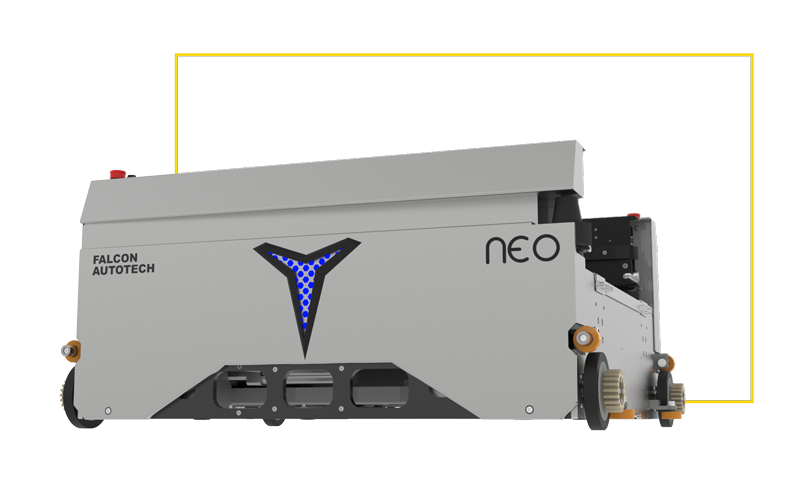
Robots that own all three axes.
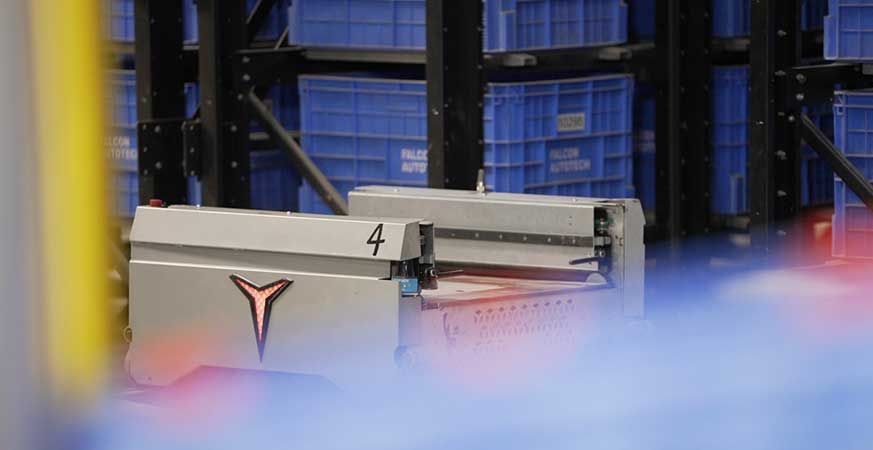
NEObots drive horizontally and climb vertically under their own power. No lifts, no conveyor hops. Because any bot can reach any bin at any rack location, the fleet is never blocked by the position of a single unit.
- Independent x, y and z travel: true three-axis mobility
- 2 m/s robot travel speed on the NEO platform
- 40 kg (88 lb) payload, heavier goods than 30 kg cube systems
- 4 motors (down from 7): simpler mechanics, lower maintenance

Modular racking, up to 12 m system height.
The NEOgrid is a steel rack structure that fits the building you already have. No floor grinding, levelling or laser alignment. It grows module by module, so capacity scales with the business rather than a forklift-based redesign.
- 12 m system height reclaims 60–85% of the floor space the same inventory occupies today
- Deploys inside the existing warehouse envelope
- No specialised flooring or laser alignment required
- Add rack, robots and bins incrementally without downtime
Containers mapped to the SKU.
NEObins are configurable multi-compartment totes matched to SKU size, velocity and order frequency. Double-deep storage with bottom extraction pushes density further without giving up access.
- 2, 3, 4, 6 or 8 compartments per bin
- 5.43 cubic feet usable capacity
- Double-deep capable with bottom extraction
- Compartment splits assigned per product profile by NEOiT
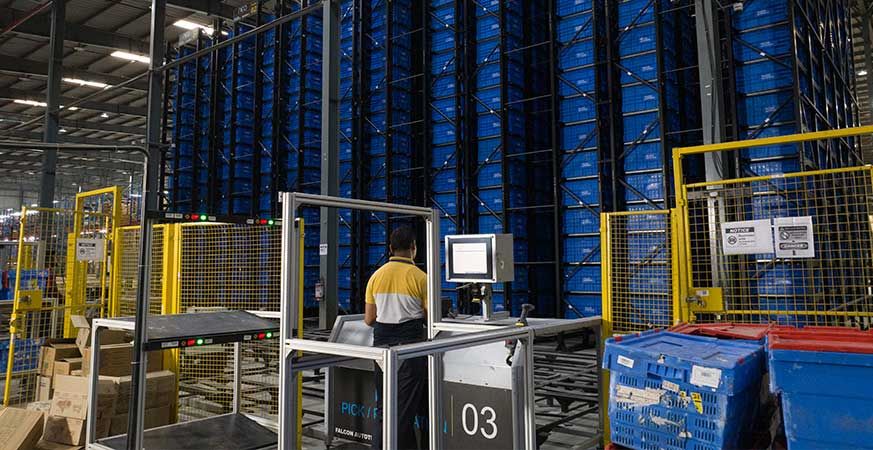
Each and case picking at 750+ picks per hour.
Operators never walk to inventory. Inventory comes to them. Ergonomic touchscreen workstations sustain high-rate pick and put, and any bot can serve any station, so a busy queue is never bottlenecked to one aisle.
- 750+ picks per hour and 180+ bins presented per goods-to-person station
- 700–800 pieces per person per hour (up from 70–100 manual)
- 4–5× picker productivity; ~75% less picking manpower
- Any-bot / any-station access removes single-aisle bottlenecks
NEOiT runs the grid. The WMS runs the business.
NEOiT is the warehouse control layer for the ASRS itself. It never replaces your WMS. Our Omni-Ware middleware maps NEOiT’s bin, station and pick state cleanly to the host WMS and ERP, so responsibilities stay clear.
Cube systems dig for your inventory. NEO just goes and gets it.
This is the whole argument. AutoStore stacks bins in a cube and its robots work from the top, so reaching a bin underneath means lifting the ones above it out of the way first. NEO runs open aisles: any robot reaches any bin at any station, directly, on the first move.
- Robots travel across the top of the grid
- Bins above must be moved to reach the one below
- Digging delays compound in hot-SKU environments
- Congestion rises exactly when volume peaks
- Any robot, any aisle, any bin, any station
- Nothing is buried, so nothing has to be excavated
- Latency stays flat as SKU velocity changes
- Throughput scales linearly with robot count
Line by line, against the cube systems.
| CAPABILITY | NEO | AUTOSTORE | EXOTEC |
|---|---|---|---|
| Payload per bin | 40 kg (88 lb) | 30 kg (66 lb) | 30 kg (66 lb) |
| Bin access | Direct: any bot, any bin | Bins above must move first | Robot climbs the rack face |
| Deepest-bin retrieval | No depth penalty | 3 min 36 s to the 16th level | Climb time to height |
| Storage height | Up to 12 m | Bins stack to 5.8–6 m | Up to 14 m |
| Bin compartments | 2 / 3 / 4 / 6 / 8 | Three bin heights | Not published |
| Motors per robot | 4 | ~7 | ~6 (climbing) |
| Robot speed | 4 m/s (X and Y) | R5: 3.1 m/s | 4 m/s travel, 1.5 m/s climb |
| Picker productivity | 4–5x manual | 3–4x | 3–4x |
| Special flooring | None — flat floor only | Flat floor, within load limits | Not published |
| Lead time to live | 4–8 weeks | 20 wks to deliver, 20–26 to install | Not published |
| Picks per hour, per station | 750+ | 500–600 | 600 |
| Bins presented per hour | 180+ | Not published as a station rate | Not published as a station rate |
| Cubic volume per bin presentation | 2.5x | Baseline | Baseline |
| Installed base | Early-stage in N. America | ~2,000 systems, 68 countries | 200+ sites, 10,000 robots |
Installed base and ecosystem maturity, with roughly 2,000 systems across 68 countries. If your SKUs are small, stable and storage density is the only metric that matters, they built the category. We will tell you that on the call.
Request a NEO Engineering Assessment.
One of our engineers reviews your SKU profile, order patterns, building envelope and throughput targets, then returns a NEO configuration and integration plan. A monthly figure follows complete project data and technical review, never before.
 is the US distribution & integration partner
Don't budget this as capital expenditure.
We own the fleet. You pay a monthly operating expense priced below the payroll it replaces, with zero capital request and zero balance-sheet impact. Payments begin only when the system hits your agreed throughput threshold.
No capital request attached
See NEO running before you commit.
Walk the virtual tour, then have one of our engineers review your operation. The monthly figure follows a complete technical review.
Questions we get every week
AutoStore, Exotec and NEO, answered plainly. If a cube system is the better fit for your operation we will say so on the call.